Showing posts with label The History of Emulation Sites. Show all posts

Sunday, January 26, 2025

Emulator and Rom Sites - Part 5

Rom Hustler

The Rom Hustler website was created in 2004. In the beginning, it offered downloads of emulators and ROMs for the main gaming systems, including computers such as MSX 1 and 2. It also had its own forum. And like any other website, it brings news about emulation. Emulanium, Retrogames, Free Roms, CoolROM and others began to become partners in the first years of the website. In 2005, a new layout and logo were created for the website. The website forum existed until 2008. In 2012, the layout and logo were changed to the ones we know today and a login system was created for the website.

Rom Hustler

This system allows unlimited downloads with a direct link, without any advertising, waiting or loading of a new page. The site was created with the domain romhustler.org, but it had also created the domain romhustler.net, which during 2004 only redirected to the .org domain. From 2005 onwards, this was reversed, and the .net extension ended up being the default for the site. This lasted until 2019, when the site once again started using the .org version. The site is updated to this day and supports the main emulators and ROMs of today.

ROM Hacking

The Romhacking website was created in 2000 by Neil. Neil was mainly helped by InVerse and Sheex. The website mainly offers utilities and documents to help you get started with ROM hacking. It all started with the website with the extension romhacking.com, which also hosted several other websites, such as Zatos, Vice and Gaijin. In 2001, the website migrated from the .com server to parodius.com, an important emulation page hosting website. With it, it also took its partner websites to Parodius. Despite this, it kept the .com domain until 2006. In 2001, it also launched the domains romhacking.org and romhacking.net (the latter paid for by its friend Koitsu).

ROM Hacking

In 2002, Neil, due to financial and personal problems, gave up on the project, leaving a farewell text only on the .com domain, closing the .org and .net domains. In 2003, a repository of information and downloads was created on the website, mainly managed by InVerse, alongside other partners. In 2006, the group that managed the website created its own forum. From 2007 onwards, the .com domain had several different owners and websites, none of them related to the world of romhacking. Regarding its layout, it only had one, used in lilac on the .com domain, and blue on the .org and .net domains. In the repository phase in 2003, it did not use a layout, it only had two banners, both in 2003. In the forum phase in 2006, it had its own layout and logo.

ROMHacking

In parallel, in 2005, a group of romhackers led by Nightcrawler purchased the domain romhacking.net, previously used by Neil. This site has nothing to do with Neil's project. Night, like Neil, had also been in the world of ROM hacking for many years. The site has its own database with all the games and translations, sent by people from all over the world, in several languages. It also provides several utilities. The site also provided its own chat. In 2006, it created its own forum. Its own Wikipedia, called Data Crystal, was created in 2010. The site changed its layout and logo in 2013 and 2017. The site is updated to this day and its news is posted on its own forum. Romhacking is considered the largest hack, translation and homebrew site in the world.

PO.B.R.E

Brazilian Romhacking, known as PO.B.R.E (Brazilian Romhacking and Emulation Portal) was created in 2007. At the beginning, more than two dozen people contributed to the site. The approach is similar to Romhacking, with translations and hacks, but in Portuguese. The site also had two partnerships, with the Unified Translation Forum, created in 2000, and with ROMHackingWiki created in 2006 (which existed until around 2008).

PO.B.R.E

It also mentioned projects, the national and international scene, tutorials and news. The site provides translations and hacks of the main consoles, arcades and portables, as well as translations of PC games. In 2015, the forum changed its address and was redesigned. The old forum files were placed in another address within the new forum server from 2016 onwards. In 2021, to celebrate the site's 13th anniversary, its layout changed. From 2021 onwards, it also started offering emulator downloads.

EmuCR

The EmuCR website was created in 2009. In fact, the website's name was just Emu, but since it was hosted on the Crimsom Rain portal, it became known as Emu Crimsom Rain. Also in 2009, emucr.com was created, keeping the same layout and creating its own logo. The website has a single goal: to inform everyone about the updates of all major emulation projects, release by release, both arcade and console projects. And something different happens, some projects announce their updates only on EmuCR, as was the case with BSNES and Higan for Super Nintendo and multi-consoles, and today with Ares, also for multi-consoles, and as is the case with SSF for Sega Saturn, among others. The website also has its own forum, also created in 2009, in addition to various utilities. The website is updated to this day.

Sega Retro

The famous Sega Retro website was created in 2011 to be a Wikipedia (or wiki, as you prefer) of Sega's history. At the beginning, it had 1,902 articles written, and today it has more than 25 thousand. A general tool about the website, it has information about all of Sega's arcade, console and portable systems. It also brings official documentation of the company's main consoles. Several products launched, such as magazines, sound equipment, karaoke, audiobooks, and a multitude of other products. Articles about the history of Sega and its creators and developers.

Sega Retro

There are also articles about consoles that are not from Sega, such as Sony, NEC, Nintendo, Microsoft and Atari. And last but not least, the emulation of Sega hardware and all its projects, forks and ports. In 2015, its layout changed to what we know today. Without a doubt, Sega Retro is the website with the most information about Sega and one of the largest about consoles and portables in general.

Emutopia

Emutopia was created in 2011 by Matthew. The project is very similar to EmuCR, with updates on several emulation projects, including lesser-known ones. Similar to Zophar, it also likes to bring emulators for less common systems, such as Linux, Macintosh, and more recent ones, such as smartphones. In a simple and practical way, with no more than three tabs, the site covers updates on the latest emulation projects, plug-ins, utilities and front-ends, and finally emulators for computers, calculators, consoles, arcades and portable devices.

Emutopia

It also usually has simple, explanatory text, often original to the project in question. It also usually offers downloadable versions of the same project for various operating systems and from different dates. In 2012, it changed its layout and logo, and in 2019, it changed the background screen. The website was last updated in 2020.

Emulation General Wiki

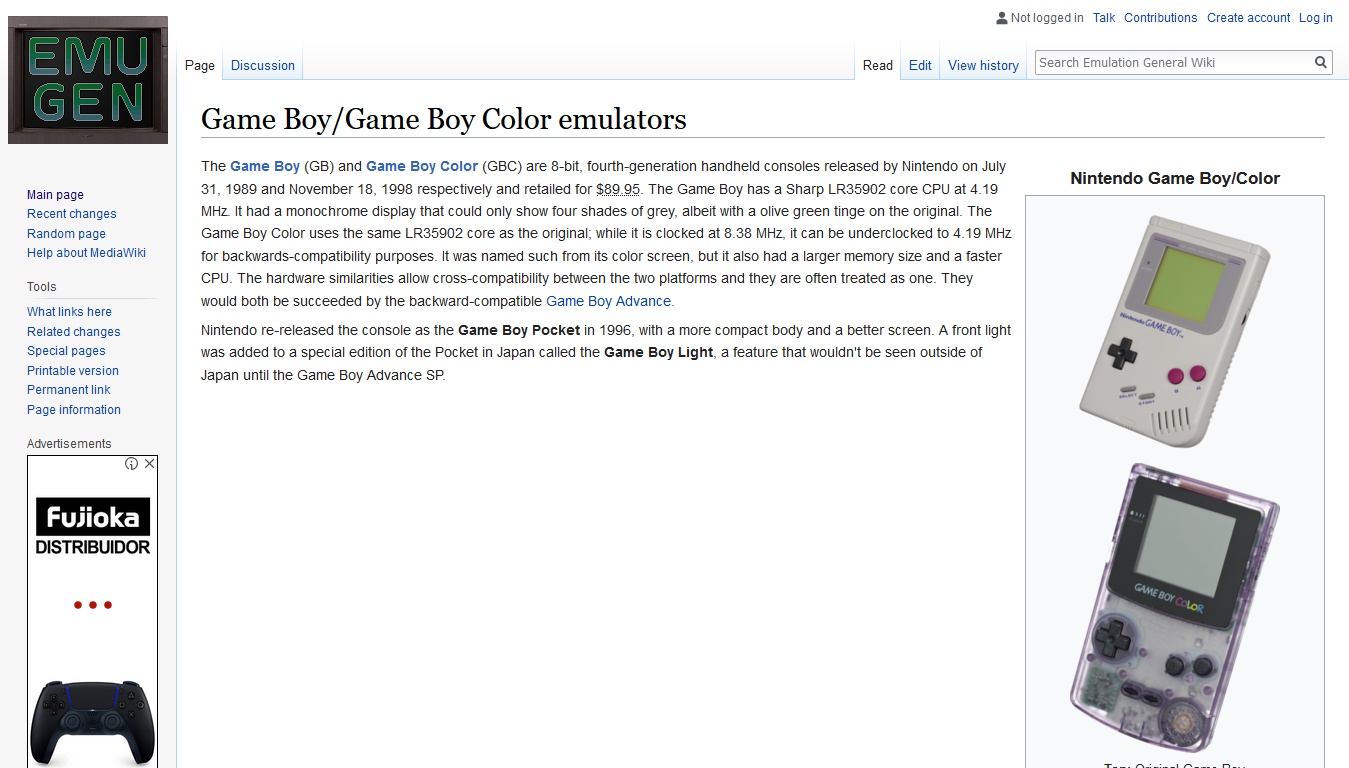
The Emulation General Wiki (Emu Gen) was created in 2013, along with the Gametech Wiki website, which deals with technical information, mods and repairs for all types of video game hardware. Emulation General is a quick Wikipedia or encyclopedia with over 500 written articles. It is extremely complete, and talks about all emulators created for gaming hardware. In addition, it follows each update of each project still in development. Like Wikipedia, each page has a description of the topic.

Emulation General Wiki

The pages are divided by hardware, and each one talks about its release, closure, predecessor, successor, generation it is part of, emulators released, multi-emulator where they run and many other details about the subject. And the pages specifically about emulators are more summarized, focusing only on them. Both pages provide the versions, official websites and other details about these software. There are also articles about questions about bios, plug-ins, ROMs, ISO, user guides for some emulators, network games, LLE and HLE (low and high level emulation), among many others. The encyclopedia is updated to this day.
CD Romance

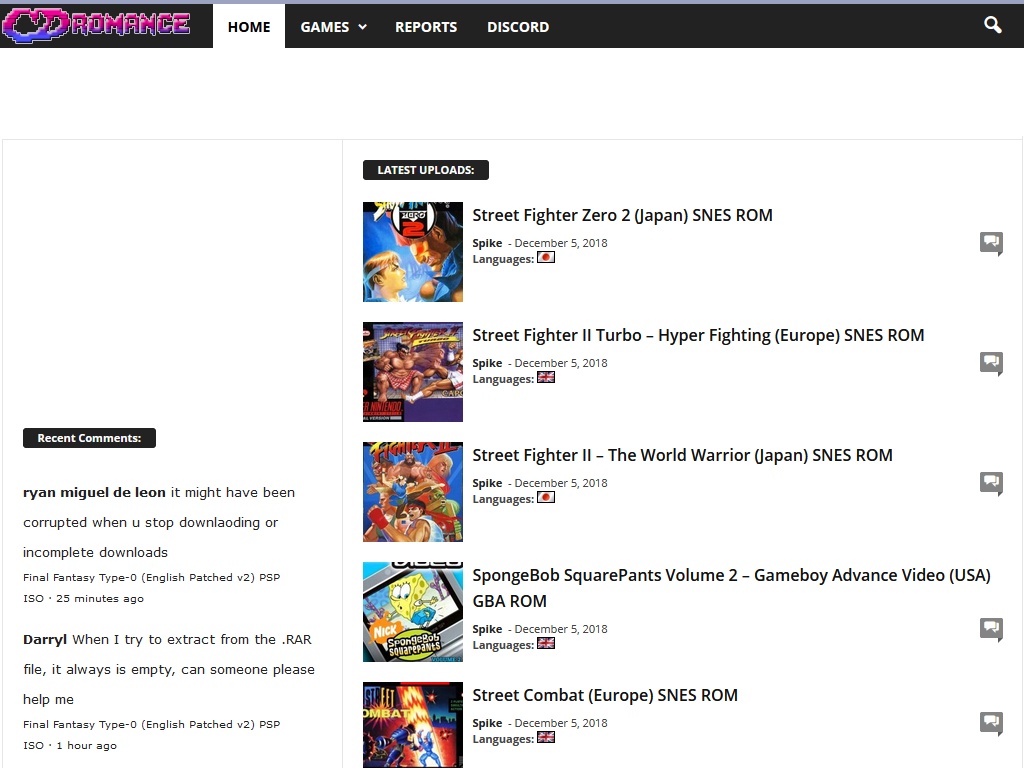
Now we get to more recent sites. The first one is CD Romance, created in 2018. Translations, romhacks, extras, such as bios and others, are some of the site's offerings. The main one is ROMs. They work with the main material from Sega, Nintendo, NEC and Sony, as well as MS-DOS and Win 3.1. They emphasize CD consoles right from the start, which is in fact their focus. Rare games from Playstation, Saturn and PC Engine are mainly found on the site. They also do great covers of scanned game covers, I believe, exclusively for the site. Regarding their layouts, as far as we have information, they have only had three, in 2018, 2021 and 2023. CD Romance is considered by many to be the favorite ROM site.

WOWRoms

WOWRoms. Created in 2018, it is the EmuParadise of today, but turbocharged. It leaves CD Romance and Planet Emu behind. It is without a doubt the largest ROM and emulator website today. It is available in six languages, including Portuguese. It has games from the main consoles from Sega, Nintendo, Atari, Sony and NEC up to the fifth generation. From arcade, it has all the classics running on MAME. For portables, it has the main ones up to the seventh generation, including Nintendo, Sega, Sony, Atari, Nokia, Neo Geo and Bandai. And computers from Amstrad, Apple, Acorn, Amiga, Commodore, Atari, Windows, Sega, Sharp, Dos, Sinclair and ZX Spectrum. The website has 156 thousand games. Their respective emulators are also there for download.

Roms Kingdom

Roms Kingdom. Created in 2019, it presents its website as a large catalog of titles to choose from in movie apps. It offers fewer systems than its competitors. 52 in total. Among consoles, portables, arcades and computers from the 1980s to the 2010s. There are almost 114 thousand games in total. It also releases emulators and bios for these systems. Roms Kingdom offers its website in six languages, including Portuguese. The website will close its activities in 2023.

Roms Games

Roms Games.net, created in 2020, is another well-known gaming website. Unlike WOWRoms, it has a wider variety of systems, totaling 105 in total, including computers, consoles, portables and arcades. It also provides access to newer generation ROMs, such as GameCube, Wii, Dreamcast, Xbox, PSP, Nintendo DS and Nintendo 3DS. In total, they have 157 thousand games, narrowly surpassing WOWRoms. The systems that win the most are Nintendo DS, Gameboy Advance, PSP, Playstation, NES, Gameboy and Wii. On their website, they also post several articles about curiosities, recent releases and others, such as apps, console curiosities, celebrations, emulators, among many others.

Romsmania

The Romsmania website was also created in 2020, and works with five specific niches, PC, Nintendo, Sega, Sony and Xbox. It only works with consoles and games released around twenty years ago. These include the Dreamcast, Nintendo 64, GameCube, Wii, Wii U and Switch, Playstation, 2, 3 and 4, Xbox, 360 and One consoles, and the Gameboy Advance, Nintendo DS, Nintendo 3DS, PSP and PSVita handhelds, with 12,600 games in total. Highlighting almost 4,000 PC games and almost 1,100 Playstation 2 games.

Romspure

Romspure is the last on the list. Created in 2021, its focus is specifically on console and handheld ROMs, including the seventh and eighth generation of consoles, such as Playstation 3 and Playstation 4, and the eighth generation of handhelds, such as Nintendo 3DS and PSVita. There are 27 systems in total with almost 28 thousand games available for download. As for emulators, it only releases Nintendo DS, GameCube, Super Nintendo and Playstation 2. The site also has articles on video games, franchises and others, mainly in the field of handhelds and Nintendo. These files are in the blog section of the site.

Wednesday, January 22, 2025

Emulator and Rom Sites - Part 4

CPS2Shock

CPS2Shock was created by Razoola in 1999. It was a website specifically focused on the coding and emulation of CPS-2 games, which at the time was the great passion of emulator creators, as it was about games from an arcade that was still releasing titles and none of them had yet been emulated. It was through the website, in January 2001, at the late Final Burn, that the news of the emulation of the first CPS-2 game was brought. Despite this, it reported the development of the main arcade emulation projects, such as WinKawaks, Callus, Nebula, FinalBurn Alpha, CPS2Mame, among many others. The website also talked about the encryption of CPS-2 games, how the boards ran, and all other technical information about the game. Regarding its domain, the first was cps2shock.retrogames.com, the best known in its golden days, existing until 2011. In parallel to it, there were two more domains, cps2shock.emu-france.com (from 2002 to 2008) and cps2shock.emu-france.info (from 2007 to the present day). These two domains served only to make CPS2 games available for download for enthusiasts (gamers and decryptors).

CPS2Shock

From 2011 onwards, when the retrogames.com domain ceased to exist, the emu-france.info domain became the default for the site, and it still operates today. And finally, the cps2shock.com domain, created in 2001, was never officially used, serving only as a redirector for the retrogames.com (from 2001 to 2011) and emu-france.info (from 2011 to 2023) domains. I believe it was created with the intention of people searching for the site in the .com domain, since it is and was the most famous domain in the world, and then serving to redirect to its site. This was very common in the past. Regarding its layout, it only had one, inaugurated in 2000. As for its logos, there were basically three, the first in 2000, and the second and third in 2001. The third one, basically loaded randomly next to it every time the site was updated, gifs of chibi fighters from Capcom, such as Dan, Ken, Chun-Li, Felicia, Ibuki, Leilei, Tessa, Morrigan, Zangief, Akuma and many other characters. The site was updated until 2016. CPS2Shock received more than 17 million visits throughout its existence.

EmuParadise

In 2000, the legendary EmuParadise website was created by MasJ. At first, it only made Nintendo ROMs available, such as Super Nintendo, NES, Nintendo 64 and Gameboy. In 2001, it expanded to include Sega and NEC consoles, Nintendo handhelds, arcades, Playstation, PC Engine and NG Pocket. In 2001, it also changed its layout. In 2002, it suffered its first attack on ROM sharing, having to take them all offline, recommending downloading them from partner sites. In 2003, it returned with ROMs, but for a few systems. At the end of 2003, it changed its logo and layout to the ones we know today. In 2006, it created its own forum, EPForums. Between 2008 and 2009, it changed its website from the org extension to me. In 2009, it returned in full with roms, and consolidated itself as one of the main sites for this genre.

EmuParadise

At that time, it began to support ROMs from the main consoles, arcades, portables and even emulated computers at the time. With Nintendo's victory in 2018 in a lawsuit against a ROM website with compensation of 12 million in damages, websites with Nintendo material on the internet began to remove it. In the case of EmuParadise, not only Nintendo's ROMs, but also those of all other consoles were taken down. They mentioned at the time that they had always suffered persecution, and as a precaution, they decided to take all ROM content down. This unfortunately killed the website, which had very few updates, ending its activities in 2020. The only things they kept on the website were the gaming magazines, the video game music, posted on the website's forum, accessed by login and password, and their gamelists, created by forum members.

Logiqx

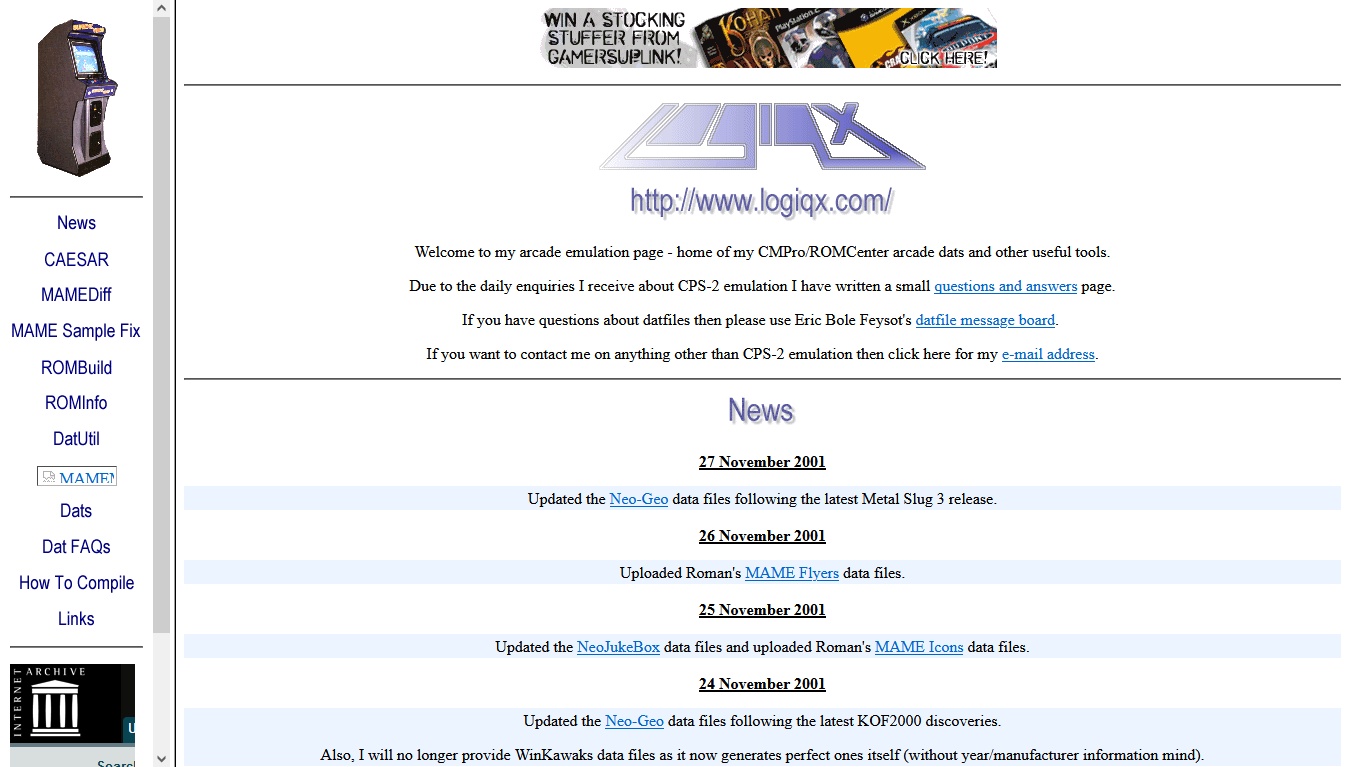
Another major website, Logiqx, was also created in 2000. Maintained by a group headed by the person who gives the site its name, Logiqx was a website that reported the update of each version of a given emulator, with the date and modifications. This information was passed on to all major arcade emulators. It also fixed the execution of ROMs in arcade emulators that did not use the standard established by MAME. In 2001, they created compilers for MAME and RAINE, to port them to other systems. They made a slight change to their layout at the end of 2005. Also in 2005, they created the Logiqx Forum, which existed until 2019. The website was updated until 2010, and was taken offline in 2023.

Caesar

Within the Logiqx website, the Caesar website was created and hosted. Created by pi, who was part of the Logiqx team, the main interest of the website was a complete library of arcade emulator creators and creations. It divided them into name, creators, systems and games they ran, latest update and official websites.

Caesar

It also mentioned the language in which each emulator was developed, which systems it ran for, which emulators were used for the processors of each emulated game hardware, as well as downloads of the emulators, their possible ports to other systems and their source code, if released by the creators. It also informed, in another part of the site, updates that were made to arcade projects. In late 2005, it added a background color to its layout. The site also stopped its updates in 2010, but like Logiqx, it kept its content active until 2023, when it also went offline.

MAME World

The MAME World website was created in 2000 by Zan, RocLobsta and KiLLerCloWn to be the largest MAME website on the internet. The website provided daily information about the emulator, including games and systems added, new versions released, such as several MAME ports, such as MAME32, NeoMAME, MacMAME and others. It also provided information about the arcade emulation scene as a whole, reporting news from several other websites on the subject. In addition to the news, it also maintained the FAQ, with frequently asked questions about the emulator. All versions of MAME for download, utilities for renaming and searching for errors and ROMs, front-ends for the emulator, such as ArcadeOS, EmuLoader and others, and MAME ports for BeOS, Macintosh, Amiga and other systems.

MAME World

Many of these front-ends, ports and utilities had external links, like most of the site, such as hosted sites, such as VAntAGE, MAMEWarp, Retroview and others, partner sites, such as EmuHQ, Retrogames, EmuUnlim, EmuViews. Among other links. In 2001, he created his own forum, added external links to arcade ROM download sites and brought in two more partnerships, such as Caesar and Zophar. In 2002, Zen left the site. Over time, all of these items mentioned began to multiply, including the hosted sites, which reached almost 50 in 2002. The forum also expanded over time, with many of the site's themes being discussed and expanded there. The website changed its layout at the end of 2000, 2001, twice in 2002, 2004, 2005, 2006 and 2008 and changed its logo at the end of 2000, twice in 2002, 2003 and 2005. The website stopped being updated in 2009, and went offline in the same year.

Retrobase

Retrobase was created in February 2000 by Christian Schaefers and Simone Mey. Its purpose was to become a complete website for searching for information on game hardware and titles. In its first year, it already covered the PC Engine, Mega Drive, NeoGeo, Atari Jaguar and Lynx consoles, totaling 1,400 cataloged games. It also provided game tracks in MP3 and MIDI, interviews, such as with Atani from Atani Software and Qunntesson from the AGES project, and partnerships with sites such as Emulation Camp, Eidolons Inn, RomCenter and others. In August 2000, about six months after its creation, Database had already totaled more than 322 thousand visits. In 2001, it expanded its list of games to include the Super Nintendo, Atari 5200 and 7800, Intellivision, ColecoVision and others.

Retrobase

That year, the company reached 4,000 cataloged games. The information was divided into images and details of the hardware, their emulators and the list of ROMs with date, genre, language and images of the title and games in action. They also made some games available for download, mainly homebrew. They even made an application called ROMS Connector available with these games in 2003, but the following year they discontinued it, also removing these games from the site. In 2004, they created their own forum 2004. Over time, the site had many dozens of people working with them, including German, American, Canadian, Norwegian, Spanish, Italian and English members. Crew joined the team as the main member in 2004. Regarding their domain, they initially used retrobase.com.

Retrobase

Its domain ends in mid-2002, and it starts to be redirected to the auxiliary domain retrobase.de, created in late 2000. In mid-2002, it also creates the domains retrobase.org and retrobase.net. Until mid-2003, the domain retrobase.de is used as the main one, until it is replaced in this regard by the domain retrobase.net. Both exist to this day. retrobase.org was shut down in 2004. Regarding the layout of the site, it changes five times. The first and second in 2000, the third and fourth in 2001 and the last in 2004. Its logo changes in 2000, twice in 2001 and in 2004. The site is updated until 2016. The ROM information remained online until 2017. At that time, the site had a total of 20 cataloged systems from 10 different companies and 5,225 games. The website is still online today.

EmuManíacos

Also in 2000, another important emulation site emerged in Brazil, EmuManíacos. Created by Cirino Souza Goulart, it had the same basic proposal as international sites, downloading emulators and ROMs. And it already included downloads of emulators for the main systems. It also made available some video plug-ins for Nintendo 64, as well as several utilities for downloading, unpacking, applying patches to ROMs, APIs, converters, programs for Joypads, game music players, among others.

EmuManíacos

In 2001, the website changed its layout and logo to EmuManíacos 2001. Between 2000 and 2001, the website was so famous that it appeared in several famous Brazilian periodicals, such as Folha de SP, Ação Games and Herói magazines, among others. Around the end of 2001, beginning of 2002, the website went offline. We can say that its existence was a meteoric success.

Emuladores.com.br

In 2001, there was a Brazilian website called Emuladores.com.br, maintained by Alexandre Neves, Daniel Teodoro Neves, Eduardo Zambaldi, Luciano Braga and Matheus Fraguas. The website consisted of making emulators for arcades, consoles, portables and computers available for download, as well as some information about the world of emulation. In 2004, the website was taken offline, stating that it was undergoing maintenance, but it never came back.

Planet Emulation

Planet Emulation (known as Planet Emu) was another of those projects that changed the history of emulation in the world. The French website was created by Masamune Shirow in 2001, and had the help of almost a dozen people in updating it. It is the kind of website that we can say is complete. In the emulation section, it lists all possible versions of emulators for each system, with a summary, version number and download site. In the ROMs section, it brings complete lists, with modified and updated versions of several ROMs, in addition to separating them by educational games, demos, and identifying each region of each game. Utilities, it adds all kinds. In addition, it also updates information on projects, writes articles since 2005 and has maintained its own forum since 2003. It also had a chat service through the IRC program (famous at the time) created in 2004, having created its own chat service in 2005 and in 2020 migrated to Discord.

Planet Emulation

In 2002, 2005 and 2013 it changed its layout. As for its logos, it changed in 2002 and 2013. From 2005 to 2013 it did not use a logo, just a banner, which later merged with the 2013 logo. Currently, they work with the emulation of 24 consoles from Atari, NEC, Sega, Nintendo, SNK, Sony, Panasonic, Bandai, Coleco, Mattel and Magnavox, 12 PCs from Apple, Commodore, Amiga, Atari, MSX, ZX Spectrum, TRS-80 and others, and arcade covering the 9 multi-emulators, MAME, FBA, FBA Neo, Kawaks, Model 2, Modeler, Supermodel, U64Emu and ZiNc. Planet Emu is one of the largest emulator and ROM sites that has been active on the internet for the longest time. At first it was not very well known, as it was restricted to France, but over time it became well-known. In the late 2010s, it began to become very popular on search sites. It has been fully updated to this day.

EmuTalk

EmuTalk (mentioned here previously) started in 2001. It is a forum dedicated mainly to Nintendo 64 emulation. It also dealt with Gameboy Advance and Dreamcast emulators, and emulators in general. In 2004, it began to discuss GameCube. From the beginning, it also had an IRC channel, which served as a chat. In 2004, it joined a network of other sites, including DCEmu and Emulation64. That year, it also changed its layout and logo. In 2006, it changed its layout and logo again and added download links, reviews, interviews, guides, articles and even the Emulation64 website homepage. We can say that it became the website's forum.

EmuTalk

In 2011, another layout update. As of 2021, the project's proposal is completely changed, completely remodeling its layout, transforming it into a website and leaving the forum separate. It leaves updates on the main emulation projects currently under development. This time, it is the Emulation6 website, which had ceased its activities, which redirects links to EmuTalk, including the home page. In this 2021 update, it returns to using the logo created for the forum in 2004. The EmuTalk website is still updated today.

NGEmu

The NGEmu website also appeared in 2001. It was previously called PSXEmu, which was created in 1999, and was the most famous website for information and downloads related to Playstation emulation. Bobbi, its creator, in 1999, was influential in the Playstation scene. In 1999, he helped with the AdriPSX project, including hosting and being the webmaster of its page. In 2000, he helped with the ePSXe project, also for Playstation. From 2002 onwards, the website ended and automatically redirected to NGEmu. On NGEmu, it focused mainly on information about the Sega Saturn, Nintendo 64, Playstation, Gameboy Advance and Dreamcast consoles.

NGEmu

There were also emulator and plug-in downloads for these systems. In 2001, there were also articles on the site and in 2003 an emulator compatibility list. In 2003, Playstation 2 and XBOX began to be discussed on the site. In 2004, GameCube. In 2006, PSP, Nintendo DS and GP2x. In 2005, the NGEmu forum was created. In 2013, the site remained just a forum. The site's layout was changed in the years 2003, 2009, 2013, 2019 and 2020. The logo changed in all of these years, except in 2009. NGEmu is updated to this day.

SNES Archive/CoolROM

In mid-2001, the SNES Archive was born, focusing on emulators and manuals for Super Nintendo games. It also made ROMs for the console available for download, as well as for other consoles, such as Nintendo 64, Playstation, NES, Gameboy Color, Gameboy Advance, GameCube, Neo Geo and others. With over 1 million hits the site had, it became a larger portal. That's when CoolROM was born in late 2001.

CoolROM

In 2004, the site began to exponentially increase its collection of ROMs. Regarding its layout, it changed twice in 2002, once in 2004, once in 2005 and once in 2006. As for its logo, it changed twice in 2002, once in 2004 and once in 2005. After that, the site's appearance was never changed again. Over time, it became one of the largest emulation sites, consolidating itself mainly in the early 2010s. Today, it is undoubtedly one of the biggest references in ROMs, especially in the Playstation 1 category. An interesting fact about the site is that it is one of the few that can be translated into several languages, including Portuguese. The site has not been updated since 2012, but it is still maintained to this day.

Emulanium

The last site to be highlighted in 2001 was Emulanium, a Spanish-Mexican language site that basically does everything the others do, downloading emulators (in the case of Atari, Nintendo, Sony and Sega) and information about emulation projects. It also released utilities and game translations. In 2002, the site began to support the English language and ROMs for Gameboy Advance, Super Nintendo, Mega Drive and NES were also added. In 2003, FreeRoms, CoolROM and Rom Hustler became affiliates of the page. In 2004, the site became entirely in English and began to add only demos and indie PC games, abolishing emulators and ROMs.

Emulanium

In 2005, the emulation and ROMs section returned to the site and also added cheats, tips and codes for games on a variety of systems to the site. Over time, ROMs for consoles, portables and arcades were added. The site changes its layout several times, such as in 2001, 2002 (twice), 2003, 2004, 2005, 2013, 2014 and 2015. The logos change in 2002 (twice), 2003, 2004, 2005, 2010, 2013, 2014, 2015, 2018 and 2022. Despite this, its last update with news was in 2020. The site maintains roms of a small niche of systems, no more than 10, and of emulators, no more than 12, as it more or less did since 2002, and returning to that in 2005.
Featured Posts

Blog Index

The History of Arcades Arcade Emulators - Williams Digital Arcade, Sparcade!, Emu / Retrocade Arcade Emulators - MAME Arcade Emulators - Sys...

Popular Posts

Total Pageviews