Monday, March 20, 2023

The History of the Atari 2600

Box and Hardware Video Computer System (Atari 2600)

The Atari company was founded in 1972, entering the arcades that same year. Its first game was the famous Pong, inspired by the ping-pong game on the Odyssey 100 console, becoming an expression to refer to first-generation games made for arcades and home consoles. The Atari 2600 began to be developed three years later, in 1975, under the name Stella. It was released in 1977 as the Atari VCS (Video Computer System), to compete with its competitor, the VES (Video Entertainment System), the first second-generation console, later known as the Fairchild Channel F. Its sales boom was at Christmas in 1979, when it was the most purchased gift in the USA. In 1976, before the VCS was released, Atari was sold to Warner Communications, heir to the film and TV productions of Warner Bros. Its hardware had a 1.19 MHz MOS 6507 CPU, a cheap version of the 6502 used in Commodore, Apple and even Atari computers, and later used in the Famicom. The sound chip (released exclusively by the company for the console) was the Television Interface Adapter, known as TIA (it was based on the TIASound audio emulation library, created by Ron Fries, which helped several Atari console emulators). The TIA was also used for video, converting it to a television signal, with support for 128 colors, and 16 simultaneously. And finally, it had 128 bytes of RAM.

Atari 2600 Box

In 1982, it reigned supreme in the American market, having surpassed its competitors Intellivision and ColecoVision. Also in 1982, with the launch of the Atari 5200, also a second-generation Atari VCS, the Atari VCS was renamed the Atari 2600, to standardize the nomenclature. The excess of games, combined with clones and poorly made games, especially those produced in large quantities, as was the case with the game ET, led to the famous video game crash of 1983, known in Japan as the Atari crash, as the main culprit was the company's console. The market only returned to normal in 1985, with a new version of the Famicom released in Japan and the following year in the USA. In 1984, Warner sold Atari, creating the Atari Corporation, continuing its work in the world of consoles, portables, arcades and computers. The console had, perhaps, the most popular games in the world, or at least in the West, which are still remembered, continued or cloned today, which came from arcade versions and other consoles, such as ColecoVision and Intellivision.

Atari 2600 Games

Among them are shmup games, such as Space Invaders, Asteroids, Megamania, River Raid, Atlantis, Crackpots, Defender, Demon Attack, Moon Patrol, Battlezone, Galaxian, Chopper Command, Sequest, Missile Command, Spider Fighter, Air-Sea Battle, Phoenix and Combat. Classic platform games, such as Mario Bros, Donkey Kong, Popeye and Joust. Platform games, such as Pitfall!, HERO, Jungle Hunt, Keystone Kapers, Spider-Man, Smurfs, Halloween, Snoopy, Superman and Sneak'N Peek (the famous Hide and Seek). Adventure/mission games in the same environment, such as Frostbite, Frogger, Freeway, Pressure Cooker and Custer's Revenge. Sports games, such as California Games, Ice Hockey, Boxing, Tennis and Fishing Derby. Racing games, such as Enduro, Motocross, Grand Prix and Pole Position. Maze games, such as Pac-Man, Ms. Pac-Man and Dig Dug. And puzzle games, such as Breakout and Q*bert. The main games were shmups, the famous spaceship games, followed by adventure, racing and sports games. The console had more than 500 games released, second only to the Famicom at the time. The Atari 2600 was discontinued in 1992, totaling 27.64 million units sold worldwide.

Come and discover the history of the Atari 2600 in video on our YouTube channel.

Friday, March 17, 2023

The History of Multi-Console Emulators - Part 4

RetroArch (2012)

RetroArch

It all started in 2010, when Norwegian Hans-Kristian Arntzen, known as themaister, created the SSNES project, which created a front-end for the BSNES emulator, bringing it as the core to the LibSNES API library, where it was accessed, releasing it in May 2010 for Windows. LibSNES was also a library accessible to other front-ends. The idea of ​​libsnes evolved, and the LibRetro API was born, expanding this idea beyond BSNES. In April 2012, RetroArch (something like retro archive) was released, which was the combination of LibRetro and the SSNES front-end, now also called RetroArch, a multi-emulator for Windows. Regarding the consoles, portables and PCs that run on the emulator, we have all Nintendo consoles and portables up to the Wii/3DS, and also all from Sega, Atari and NEC (such as PC Engine). The Odyssey 2, ColecoVision, Vectrex, PS1 and 2 and 3DO consoles. The NG Pocket series, WonderSwan series and PSP portables. The Amstrad CPC, Commodore 64, Atari Falcon, MSX 1 and 2, ZX Spectrum, ZX81 PCs, and all Thomson computers, as well as almost 100% of the arcades produced in the 1980s and 1990s, and some arcades produced in the 2000s, reproducing them through the MAME, MESS, FB Neo and FBA emulators.

RetroArch (Lakka)

By January 2014, less than two years later, RetroArch was already on seven different platforms, that is, fixed and portable hardware systems with the widest possible variety of execution. Speaking of systems, we have a range of operating systems where the software ran. Among them the most classic Windows, MacOS X, Linux and Ubuntu, in addition to RetroPie. The PS2, 3 and 4 consoles, Xbox, Xbox 360, One and Series, Nintendo Wii, Wii U and Switch. The PSP, PS Vita, Nintendo 2 and 3DS portable systems. Mobile and portable systems, such as Android, iOS, BlackBerry, OpenPandora, OpenDingux, and GCW Zero. And even on Steam (an online gaming service), through Steam Link. Speaking of Steam, it started to be part of it in July 2019. In July 2014, the emulator's front-end gained its own operating system, Lakka. Developed by the LibRetro community, Lakka was built on top of RetroArch itself, being based on the LibreELEC Linux system, which in turn was created to run the media center, Kodi.

RetroArch

In total, we have 28 consoles, 15 portables, 19 PCs, and around 200 arcades running on the software. Regarding emulators, in addition to those already mentioned, we have well-known emulators such as 4DO, Stella, Handy, Nestopia, Higan, mGBA, VisualBoyAdvance, Dolphin, Picodrive, Genesis Plus GX, PPSSPP, PCSX-ReARMed, Snes9x, uoYabause, among others. Several of their emulators came from the Mednafen project. Regarding particular emulation features, we have, among others, audio plug-ins for equalization, sound reverberation, and other functions. Advanced save state resources. Rewind games frame by frame. In addition to support for the OpenGL and Vulkan APIs, giving different graphical support to the emulators. Regarding Vulkan, it was one of the first systems/software to implement it, doing so on the same day of its launch, in February 2016. Regarding problems, one of its biggest criticisms is the difficulty of configuring emulators and ROMs, due to the numerous options available to the user. On the other hand, it is also praised for several advanced features it has.

RetroArch: VBA Next and bSNES

In November 2016, due to the costs of developers who helped the project, and the online netplay services themselves, they would be joining the Lakka system on Patreon to reimburse costs. In December of the same year, the RetroArch team, known as The LibRetro Team, was reportedly approached by GoGames, which produces games for Sega, to use RetroArch in the Sega Forever project, but this never happened. Sega Forever was a project that distributed its old games for purchase and execution on modern operating systems. The emulator's last update was in May 2021. RetroArch also had a fork, RALibRetro, released in April 2018 also by The LibRetro Team, creating the possibility of achievements in the games, that is, challenges that, if overcome, bring rewards. The project is still in development, and its latest version was released in October 2020.

Phoenix (2014)

Phoenix

Phoenix (3DO/Road Rash)

Phoenix (3DO/Super Street Fighter II Turbo)

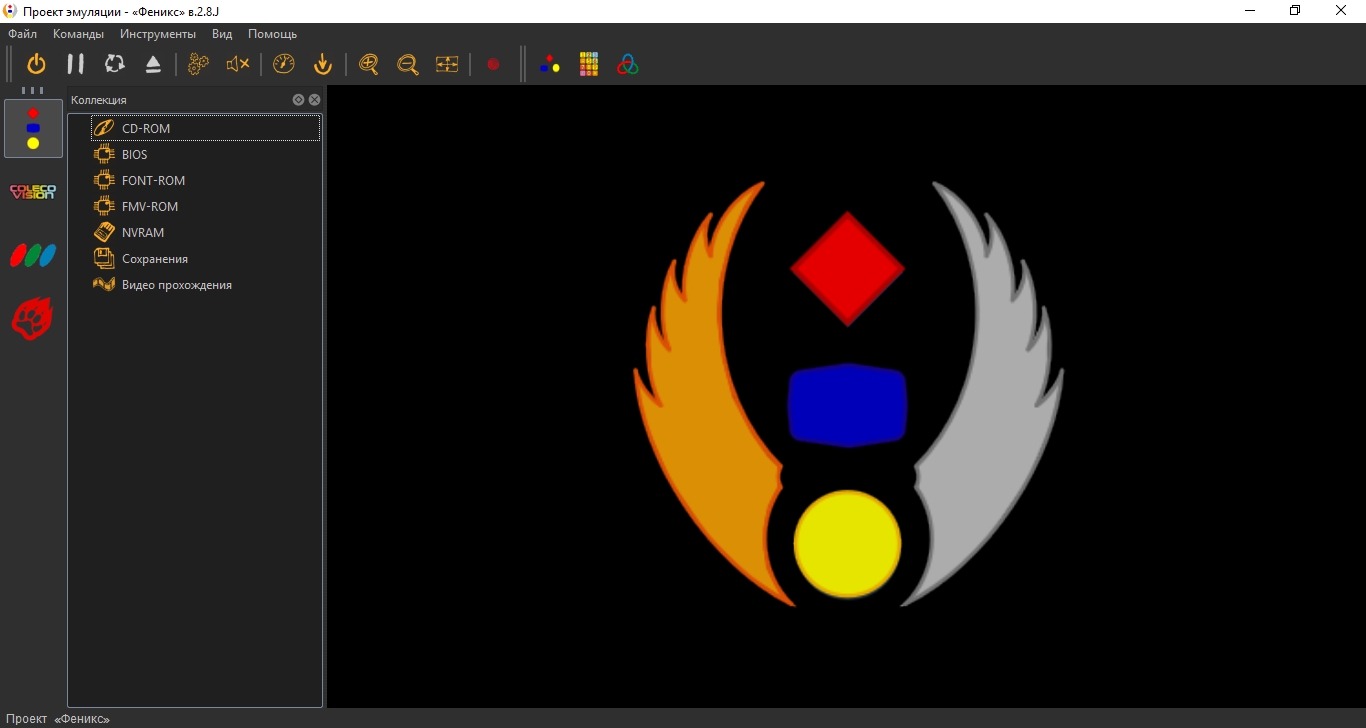
The Phoenix project, also known as PhoenixEmuProject, was started by Russian Maxim Grishin, Altmer, in August 2006 with the aim of emulating the Atari Jaguar console. At the time, he was part of the FreeDO project, also for the Atari Jaguar, and was helped by members of the project with his emulator. He had hoped to re-found the FreeDO emulator, but ended up not getting support from the group, and so he continued his project alone. The name Phoenix comes from the game Phoenix 3 for the console that Altmer won along with the console when he was a child.

Phoenix (ColecoVision/Antarctic Adventure)

Phoenix (Sega Master System/Monaco GP)

Phoenix (SG-1000/Wonder Boy)

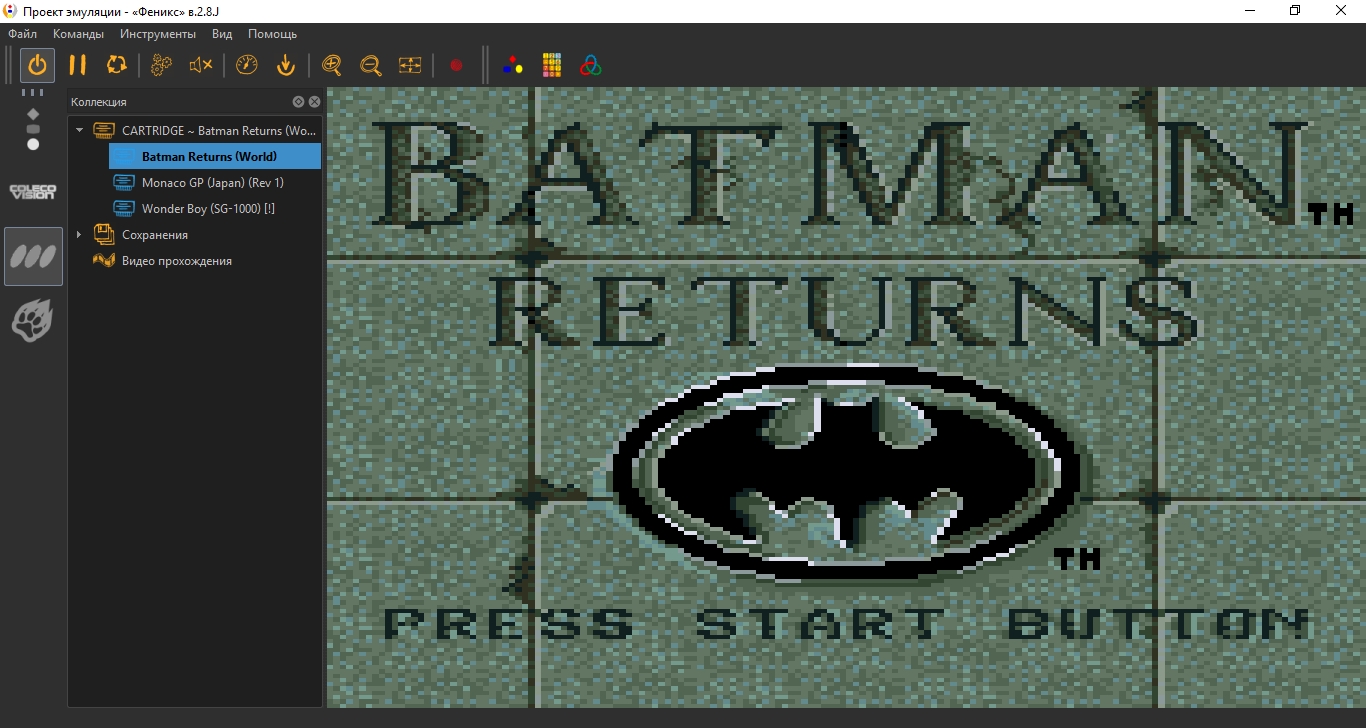
Phoenix (Game Gear/Batman Returns)

Phoenix (Atari Jaguar/Rayman)

The emulator was only released eight years after its inception, in early 2014 for Windows and Linux. At that time, Altmer had already rewritten the emulator from scratch. The emulator is able to develop 100% compatibility with the console's games. In April 2016, it became a multi-console emulator, adding emulation for the Master System, Game Gear, ColecoVision and Atari Jaguar (the first three with the same hardware processing base), with the last one added in May 2017. All emulators ran almost 100% of the games. Its last release was dated June 2017. It even had a version for MacOS X in January 2018. From February 2016 to November 2019, it was released with separate versions of each console (except SMS and GG which were released together) for Android.

Other Emulators

OpenEmu

PicoDrive and Kega Fusion were also multi-emulators, however, since they did not cover consoles from companies other than Sega, I thought it best not to include them in this specific part of the article. Other emulators also followed similar paths to those mentioned above.

RetroCopy and VDMGR

SmartGear

DSP Emulator (also for Linux) (which emulates computers and the ColecoVision), emulator (runs NES/SMS/GG/GB), Ninth Star (runs NES and Atari 2600), RetroCopy (runs SMS, NES, MD, GG, SG-1000 and the Sega System E arcade), SmartGear (runs GB, GBC, NES, GG, SMS, TurboGrafx 16 and MD), YAME (runs NS, SNES, GB and TG-16), Mimic (runs arcades from 1978 to 88 and the SMS, GG, Coleco, SM3, MD consoles, and almost supported NES and S-CD), OpenEmu (runs Sega 8 and 16-bit, Nintendo 8, 16, 64-bit, GB, GBC, GBA, VB and DS, NEC PCE, PCE CD, TG-16, TG-16 CD and PC-FX, Atari 2.6k, 5.2k, 7.8k and Lynx, Coleco, INTV, Vectrex, Sony PSX and PSP, NG Pocket and WonderSwan), VDMGR (runs NES, NG Pocket, Sega SG1, SMS3, Coleco, as well as computers with MSX and others), among others.

Tuesday, March 14, 2023

The History of Multi-Console Emulators - Part 3

Xe (2004)

Xe

The Xe emulator was born in 2004 with the proposal of being a multi-emulator, running consoles and portables. Created by Jimmy, its first version was released in November 2004 for Linux, already featuring the SG-1000, NES, Master System, PC Engine, Turbo Grafx 16, Mega Drive, SNES, Neo Geo, Game Boy, Game Boy Color, Game Gear, Neo Geo Pocket, Neo Geo Pocket Color, Wonder Swan and Wonder Swan Color systems. In the following versions, new consoles were added, such as PC Engine CD and Turbo Grafx 16 CD on 03/05, Sega CD on 05/05, Neo Geo CD on 08/05, Super Grafx on 09/05, Famicom Disk System on 07/06, CPS Changer on 11/06, FM Towns Marty on 04/08, and PC-FX and Game Boy Advance on 08/08. The Windows version will only be released on May 1st. Initially, the Windows version cost $35, with a free demo version. In mid-2006, a free full version of Windows was also released.

Xe (Interface)

There were versions for other systems, such as PowerPC 64 on 10/07 and Linux 64 bits on 12/07. The project had help from important people, such as the MAME and MESS groups with information about various chips, as well as Charles MacDonald, for obtaining information about the PC-Engine and Sega Master System/Game Gear and Mega Drive systems, since he had developed emulators for the consoles in question. Its latest version was released in April 2009. The project emulated 24 systems in total. In July 2009, Jimmy had proposed adding N64 emulation to the project, even releasing screenshots of this evolution, but this never came to fruition.

Mednafen (2005)

Mednafen (MedLaunch)

Mednafen was created in August 2005 as an NES emulator called Nintencer by Ryphecha. It was a system that ran on a simple CPU and without special video features. Three versions of the emulator were released in August, until Ryphecha decided to turn it into a multi-emulator, releasing its first version in September under the name Mednafen, which stands for My Emulator Doesn't Need A Frickin' Excellent Name. Creative, huh? LOL. At least it's original. :p With that, he gathered a team to help him, called the Mednafen Team. Its first version was released for Windows and Linux. Upon its release, it already emulated the Atari Lynx, Game Boy, Game Boy Color, Game Boy Advance, NES, Famicom Disk System, PC Engine, Turbo Grafx 16, Super Grafx, and PC-FX systems. The emulator's proposal is very similar to that of MESS, being a multi-emulator for consoles and portable devices and working via the command line. It is made in SDL, meaning it can run on any operating system, and has all the standard features of a good emulator, such as screensaver, save state, multiple joypad configuration, among others. Another difference is the graphics execution via OpenGL, which are plug-ins/APIs that simulate graphics hardware for each system according to the standard video hardware/software of each user. At this time, emulators are already starting to use OpenGL even on consoles where sound chips can be easily emulated, bringing substantial improvements to the graphics with the simulation.

MedAdvCFG

Mednaffe

NekoLauncher Mednafen

Ice cold

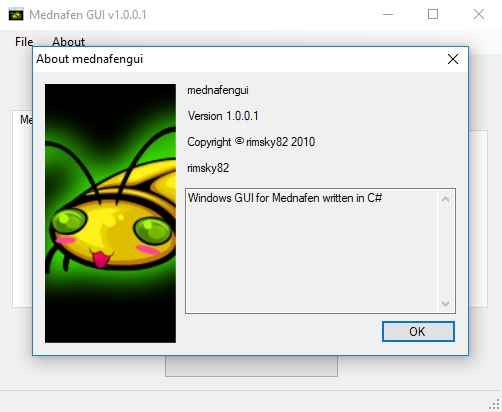
The addition of emulators to Mednafen are as follows: In 2005 GB, GBC and GBA by VisualBoy Advance, NES by iNes and FCE Ultra (which their NES emulator had already been inspired by), Atari Lynx by Handy, and PC Engine and the other NEC FX with original emulation. In 2007, WonderSwan and WonderSwan Color based on Cygne were added, and Master System and Game Gear based on SMS Plus. In 2009 we have the Mega Drive based on Genesis Plus, with sound from Gens, and Genesis Plus code for GameCube/Wii (the Genesis Plus GX). In 2010 the Virtual Boy was included with original emulation, and SNES emulated by BSNES. In 2011 they developed their own emulator for PSX, which was ported in 2016 to RetroArch as Beetle-PSX. In 2012, they began emulating the PC Engine CD based on the Japanese PC2E emulator. And in 2016 they emulated the Sega Saturn through the MedSat emulator, developed exclusively for the multi-emulator by Paul Met, which also has its own GUI for the console.

MedGui Reborn

QMednafen and Mednafen GUI

JMednafen

MFE

Speaking of GUI/Interfaces, the emulator has been released for a wide range of systems, such as Windows, as MedGui Reborn in June 2009, Mednaffe in August 2010 (also having a version for Linux), Mednafen GUI in November 2010, QMednafen in June 2014, MedAdvCFG in June 2016 and MedLaunch in October 2016. For Linux, as Gelide in December 2008, Zednafen in July 2011 and Mednafen Front End (MFE) in November 2011. For MacOS X, as NekoLauncher Mednafen in September 2016. And for Java, as JMednafen in August 2008. Mednafen's last update was in April 2021. The emulator also runs on Free, Net and Open BSD systems, and Risc OS, in addition to consoles. PS3 and Nintendo Wii. The emulator was also forked as Mednafen Re-Recording in April 2009. This is a version for recording videos in the emulator, a type of fork common with other emulators. Its latest version was released in July 2009.

Bee (2009)

Bee

Bee (Interface)

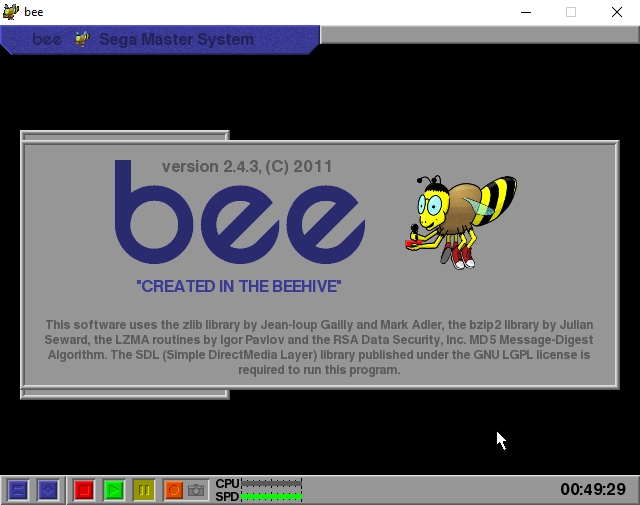
Bee was an emulator built by The Beehive group starting in 2007. Its first release was in June 2009 for Windows, Linux and MacOS X. It supported the second and third generation Atari 2600, ColecoVision, SG-1000 and Master System systems, all with the same Zilog Z80 microprocessor, with the exception of the Atari which used the Motorola 6502, all already very well documented and emulated at the time. It was not public domain, nor open source and had an emulation precision that required having a good PC at the time to run it.

 
Bee (Atari 2600)

Bee (ColecoVision)

Bee (SG-1000)

Bee (Master System)

Regarding its interface, it was one of the most complete multi-system emulators of the time, providing a summary of each console with images of them, control configuration, with the skin of the controls of each console, save state, video filters, OpenGL acceleration, 3D configuration, fullscreen, various window resolutions, buffer configuration, volume and sound sample rates, loading zip files, selection of video output between PAL, NTSC and SECAM, as well as video recording and snapshot, among others. Its latest version was released in March 2011.

Featured Posts

Blog Index

The History of Arcades Arcade Emulators - Williams Digital Arcade, Sparcade!, Emu / Retrocade Arcade Emulators - MAME Arcade Emulators - Sys...

Popular Posts

Total Pageviews